AI SEO Service Myths, Checked: What Are They Actually Selling?
Close to ten years ago, when I was a paid search manager, I had a discussion with the SEO expert I worked with about the different philosophies of SEO. He didn't agree that someone doing purely backlink building and keyword stuffing was doing good SEO. But to an inexperienced person, they wouldn't know that.
That conversation came back to me recently, when I started seeing ads for AI services that promise to run your SEO for you.
In the last set of myths I looked at claims about showing up in AI search answers. This set is about the services selling to do your SEO for you, using AI.
What are these services promising?
I'm not going to name names, because the point isn't about any one company. But here are lines from two services I came across, taken from their own marketing pages, and one claim paraphrased because the wording varies:
- "1 article/day + backlinks"
- "30 to unlimited articles per month"
- "Launch 10x more SEO content that ranks on Google and ChatGPT"
- SEO work that's "fully automated" (the exact wording varies from site to site)
- "50-140% more organic traffic"
Notice what they have in common. They describe how much gets produced. They say very little about what it achieves.
What does "automated SEO" actually mean?
It can mean three quite different things:
- Automated tasks. Site audits, rank tracking and reporting. Tools have done these for years.
- AI-assisted work. AI scans pages, suggests changes and drafts content, and a person reviews it.
- Fully automated publishing. AI picks the topics, writes the articles and posts them, with nobody checking.
The pitch tends to blur these together. What's mostly being sold is the third, while borrowing the credibility of the first two.
How do I rate each myth?
- Busted: the evidence goes against it.
- Mostly false: there's a grain of truth, but it doesn't hold as worded.
- Plausible: true in some cases, but too broad to prove or disprove as worded.
- Mostly true: the evidence supports it, with caveats.
"Plausible" isn't praise. A claim that's too broad to test, like "better" or "10x", is easy to sell and hard to hold anyone to. That's often a sign of marketing language, though honest people make broad claims too.
Myth 1: "An article a day gets results"
Mostly false.
Think of two ways to go to the gym. One is three sessions a week on your own, with bad posture, too little effort or too much weight. The other is one session a week with a personal trainer who corrects your form. The first looks like more effort. The second may get better results.
Daily publishing sells the three sessions a week. It rarely mentions the form.
Here's what Google has said. A Google representative answered in 2022: "Posting daily or at any specific frequency for that matter doesn't help with ranking better in Google search results." In fairness, the same answer added that more pages in the index can mean more chances to show up. [1] John Mueller put the other side as "making less content and making better content." [1] Google's current guide for AI search says "a high quantity of pages doesn't make a website higher quality or more relevant to users", and that creating separate content for every variation of a search, mainly to manipulate rankings, violates its scaled content abuse policy. [2]
To be fair, some sessions with imperfect form still beat not going at all. If you do no SEO today, a few genuinely useful articles are better than none. Volume for its own sake isn't: Google says mass-produced content made mainly to manipulate rankings breaks its spam policy. [2] So the real question is whether it's worth the monthly fee, and whether it can do harm.
Myth 2: "AI can run your content with nobody checking it"
Mostly false.
I'd be wary of any human writer who writes articles for clients without ever checking with them. An AI that scans your website for topics is in the same position. As I understand it, it's working from your own pages and whatever it can find about your space, and I haven't seen inside any of these products. Either way, it isn't talking to your customers.
Google's checklist for helpful content asks whether your content provides "original information, reporting, research, or analysis" and "first-hand expertise", and whether you're "mainly summarizing what others have to say without adding much value." The same page says "using generative AI to produce large amounts of text without manual oversight or curation represents little to no effort." [3] Its AI search guide adds: "Don't just recycle what others on the internet have already said, or could easily be produced by a generative AI model." [2]
There's also the accuracy problem. AI makes things up, as I covered in Why Does AI Make Things Up?, and with nobody checking, nobody catches it. An automated article about something like electrical safety, where one wrong detail matters, is a good example.
Myth 3: "Google penalises AI-written content"
Busted.
This is the opposite myth, and it isn't true either. In an Ahrefs study of 600,000 pages, about 86% of top-ranking pages contained some AI content, but only 4.6% were entirely AI. Most were a mix of AI and human, and the study found no meaningful link between how much AI a page had and how it ranked. [4] It used Ahrefs' own AI detector, so treat the exact figures as approximate.
Google's guide says the same thing in its own way: if you use AI tools to help, make sure the work meets its quality standards and spam policies. [2] So the problem isn't AI. It's having no human involved.
Myth 4: "More backlinks every month means better SEO"
Mostly false.
Some of these services bundle in a number of backlinks a month. Quantity isn't the point. Mueller said the total number of links "doesn't matter at all", and that one good link from a relevant, respected site can be "a really important sign". [5] Other Google staff have said people overestimate links: Gary Illyes said in 2023 that he didn't agree they're a top-three ranking factor, and Mueller said in 2024 that "over-focusing on links will often result in you wasting your time". Neither said links don't matter. [10] [11] Google also says its systems can detect sites buying links and sites that exist to pass links on, and that the credit from those links is lost. [6] The question to ask is where the links come from. If the answer is vague, treat that as the answer.
Myth 5: "Send paid clicks to your site and Google will move you up within days"
Mostly false, as it's sold.
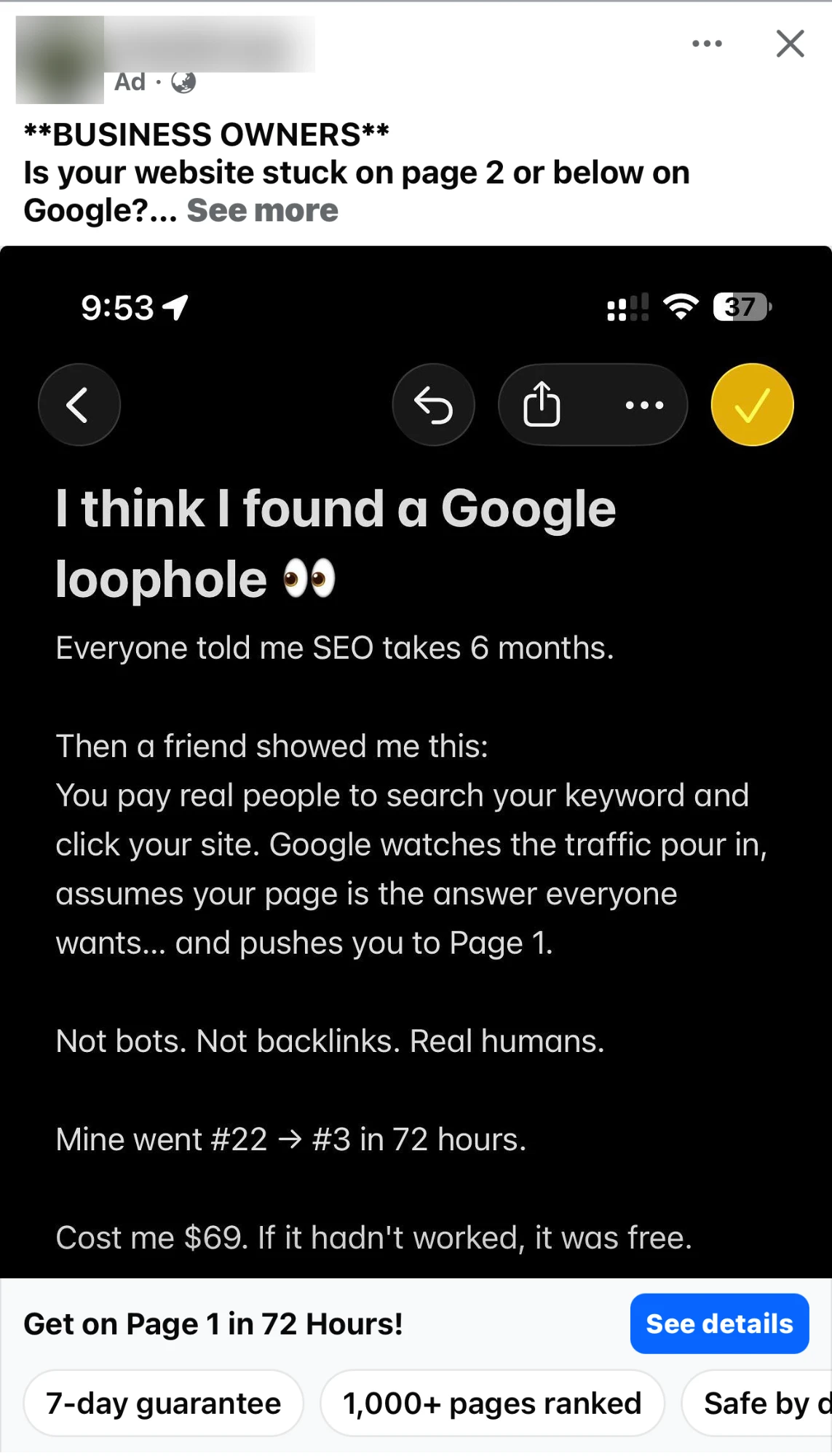
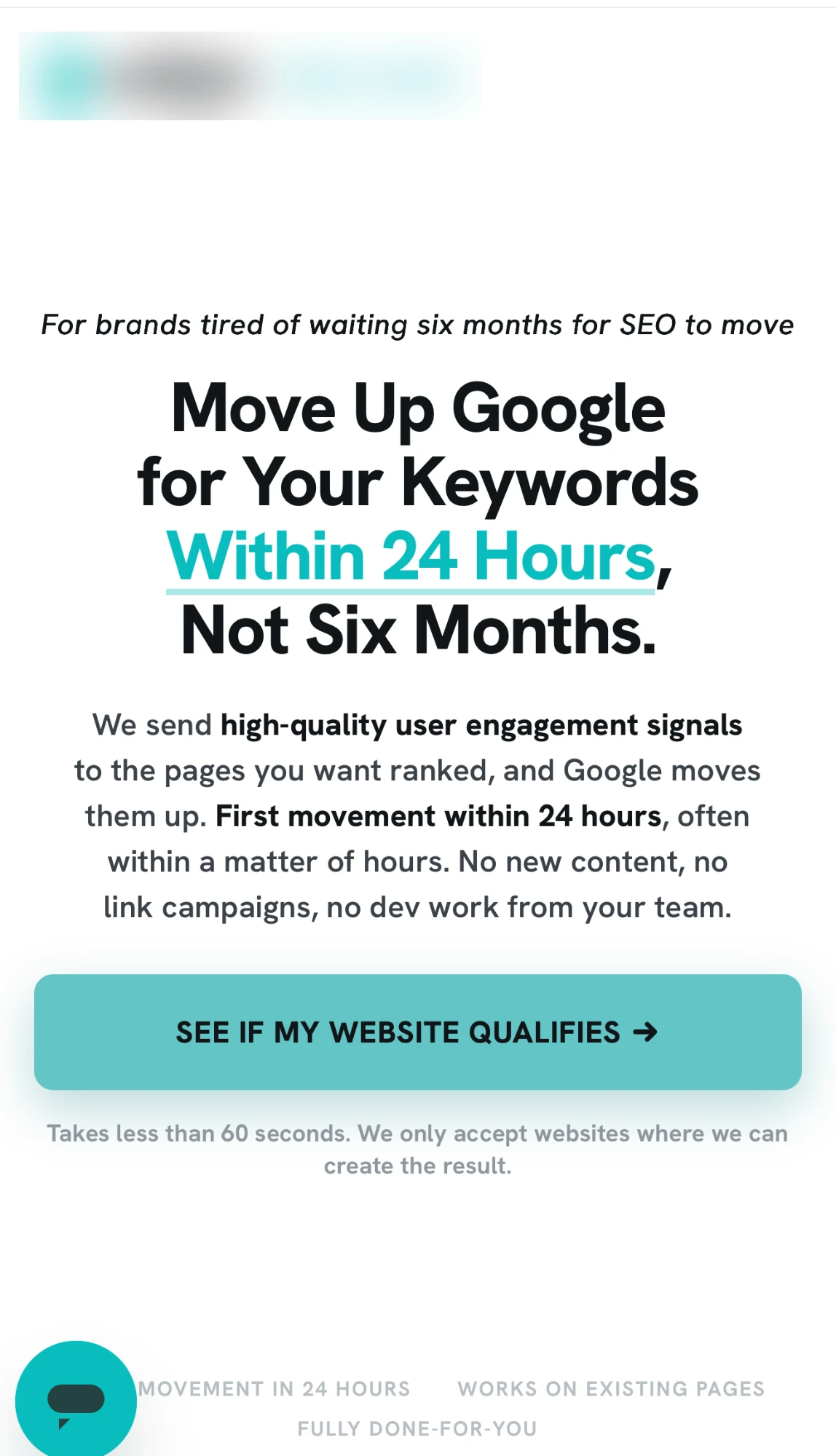
This one isn't an AI pitch, but it's the same family of "secret trick" SEO ads, and I saw two versions of it on Facebook while writing this. One said someone had "found a Google loophole": you pay real people to search your keyword and click your site, Google "watches the traffic pour in" and pushes you to page 1, and the poster's site went from #22 to #3 in 72 hours for $69. The other promised to move you up Google for your keywords "within 24 hours, not six months" by sending "high-quality user engagement signals" to your pages, with no new content, links or dev work.
Both are the same idea: generate clicks and activity, and Google will treat the page as popular. I'd call the mechanism not absurd and the outcome unproven. Here's what's known:
- Google's Gary Illyes said in 2016 that click-through rate isn't a ranking factor, and that "clicks in general are incredibly noisy". [7]
- Court and leak material has since suggested click data feeds into ranking in some form, often called Navboost. How it's used, and how much, isn't confirmed, and the one write-up I found on it is partly the author's own educated guessing. [8] None of it shows that paying for clicks works.
- I couldn't find Google's own wording on paid clicks, so I can't tell you what it says. Clicks from people paid to do it are exactly what a system built on "noisy" clicks would be expected to discount, but that's my reasoning, not a quote.
So click data may matter, but neither ad shows its working. The first is one success story with no keyword, search volume or starting point. The second gives no example at all, and its small print says "first movement within 24 hours", which is a much smaller promise than "move up Google". A page can move for ordinary reasons, and keywords with little competition move easily. The ads also don't agree with each other: one says 72 hours, the other 24.
Some of the wording is a sales tell too: "loophole", a made-up objection ("Everyone told me SEO takes 6 months"), a testimonial in the seller's own voice, a guarantee, "1,000+ pages ranked", and "we only accept websites where we can create the result", which means the sellers pick the cases that look good.
Myth 6: "You'll get 50-140% more organic traffic"
Plausible.
It could be true for someone. But "50-140% more", with no baseline, no timeframe and no definition of "organic traffic", is too broad to prove or disprove. Fifty per cent more of very little is still very little. That's what I mean by a claim that's easy to sell and hard to hold anyone to.
And traffic isn't customers. Typical ecommerce conversion rates sit around 2.3% to 2.7%, [9] so most visitors never buy. If the claim doesn't say what the extra traffic does for your enquiries or sales, it can't tell you whether it was worth paying for.
Myth 7: "AI SEO is better than human SEO"
Plausible.
This one is too broad to rate, because SEO is several different jobs. AI can help with some of them and does little for others:
| Area | AI can help with | Still needs a human |
|---|---|---|
| Content and blog | Drafting and research, faster | Accuracy, first-hand experience, what your customers actually ask |
| Links and off-site | Finding possible sites to approach | Real relationships. Bought or mass-produced links are what Google's systems look for |
| On-page | Scanning pages and suggesting titles, headings and gaps | Judging whether the suggestions suit your customers |
| Technical | Spotting issues quickly | Deciding which ones matter |
The first two rows are backed by the Google quotes above. The last two are my reasoning, not evidence, so take them as a rough guide.
That's the honest answer to "better". AI can scan pages faster and suggest content, but that doesn't guarantee quality. Even Google's guide says to be wary of third-party tools that promise ranking success: "No third-party tool has access to our internal ranking or AI systems." [2]
What isn't a myth?
Mostly true: AI-assisted content can rank. The Ahrefs data above shows most top pages are a blend of AI and human work. Having an AI do research and analysis is probably cheaper than doing it by hand, and it can find gaps, suggest topics, check your pages and produce first drafts. But you still need a human who knows the business to decide what customers actually ask, check the facts, add what only you know, and judge whether it's working. That's the trainer in the gym comparison.
What are the red flags in any SEO pitch?
These apply to human agencies as much as to AI products:
- It makes claims too broad to test ("better", "10x"), or gives numbers with no baseline or timeframe.
- It promises results but sells activity, such as articles published or words written.
- It claims everything is automated, so nobody checks the work.
- Success is measured in traffic, not enquiries or sales.
- Nobody can explain where the backlinks come from.
So is it worth it?
It depends on what you're buying. As a cheap drafting assistant for someone who will read and improve every article, it could be worth it. As a "set and forget" replacement for judgement, I'd be sceptical. Before paying, ask:
- Who reads each article before it's published, and is it me?
- How are the topics chosen, and from what?
- Where do the backlinks come from?
- How will success be measured: enquiries and sales, with a baseline and a timeframe?
- What do I keep if I stop paying?
Good SEO is hard to judge from the outside. That was true ten years ago, and it's true now. So ask for the form, not just the sessions.
Sources
- Search Engine Journal, Does adding content daily increase rankings?, reporting a September 2022 Google SEO office-hours answer and a February 2022 Mueller comment.
- Google Search Central, Optimizing your website for generative AI features on Google Search, last updated 10 July 2026.
- Google Search Central, Creating helpful, reliable, people-first content.
- Search Engine Journal, Ahrefs study finds no evidence Google penalizes AI content. Ahrefs analysed the top 20 results for 100,000 keywords using its own AI detector.
- Search Engine Journal, Google's John Mueller: total number of backlinks doesn't matter, February 2021.
- Search Engine Land, Google December 2022 link spam update done rolling out.
- Search Engine Journal, Is click-through rate a Google ranking factor?, which collects Google statements including Illyes in 2016.
- Search Engine World, Pushing NavBoost: in three parts. Secondary source; it draws on trial and leak material and labels its own analysis as guesswork.
- Blend Commerce, Ecommerce conversion rate benchmarks 2026, citing IRP Commerce, Dynamic Yield and Shogun.
- Search Engine Land, Links are not a top 3 Google Search ranking factor, says Gary Illyes, reporting his comments at Pubcon Pro in Austin in 2023.
- Search Engine Journal, Google: overfocusing on links could be a waste of time, 1 April 2024.
alltools.solutions builds free and paid tools, sometimes in the same space as what's discussed here. Nobody mentioned in this post paid for or reviewed it, and nobody pays us to mention them. We hold our own tools to the same rubric we'd apply to anyone else's.